

A shop vac that’s too small means emptying the tank every ten minutes. One that’s too big won’t fit next to your car. Getting the size wrong is the most common mistake homeowners make buying their first garage vacuum, and it’s an easy one to avoid once you know what actually matters.
This guide compares four wet/dry vacuums built for garage and workshop cleanup, from a 2.5-gallon detailing vac to a 16-gallon heavy hitter, each verified for current price, stock status, and real buyer ratings on Amazon. Capacity, suction power, and hose diameter separate the vacs that earn a permanent spot in your garage from the ones that end up in a closet after one project. If you want the short answer first, the CRAFTSMAN 16 Gallon 6.5 Peak HP Wet Dry Shop Vacuum handles the widest range of garage messes without constant emptying.
The rest of this guide breaks down exactly why, plus three other options for smaller garages, tighter budgets, and shared walls where a quiet motor matters more than raw power.
Table of Contents
- Top Picks at a Glance
- Capacity: How Big Should Your Garage Vacuum Be?
- Suction Power: Peak HP vs. CFM Explained
- 16 Gallon Shop Vac vs 12 Gallon Shop Vac: Which Size Wins?
- Hose Diameter and Length
- Corded vs. Cordless vs. Wall-Mounted Shop Vacs
- Shop Vac vs Regular Vacuum: Why It Actually Matters
- Filtration: HEPA, Cartridge, and Dust Bags
- Noise Level: What Decibels Mean for an Attached Garage
- In-Depth Reviews: The Best Shop Vac for Garage Picks
- Side-by-Side Comparison
- Which Shop Vac Fits Your Garage?
- How Do You Keep a Shop Vac’s Suction From Dying Early?
- Frequently Asked Questions
- Final Verdict
Top Picks at a Glance
The best shop vac for garage use is the CRAFTSMAN CMXEVBE17595, a 16-gallon, 6.5-peak-HP model priced at $149.99 with a 4.7-star rating across 8,612 reviews. Its oversized drain and large tank handle heavy debris and wet spills without frequent emptying, making it the strongest all-around pick for a dedicated garage or workshop space.
| Product | Best For | Price | Rating | Buy |
|---|---|---|---|---|
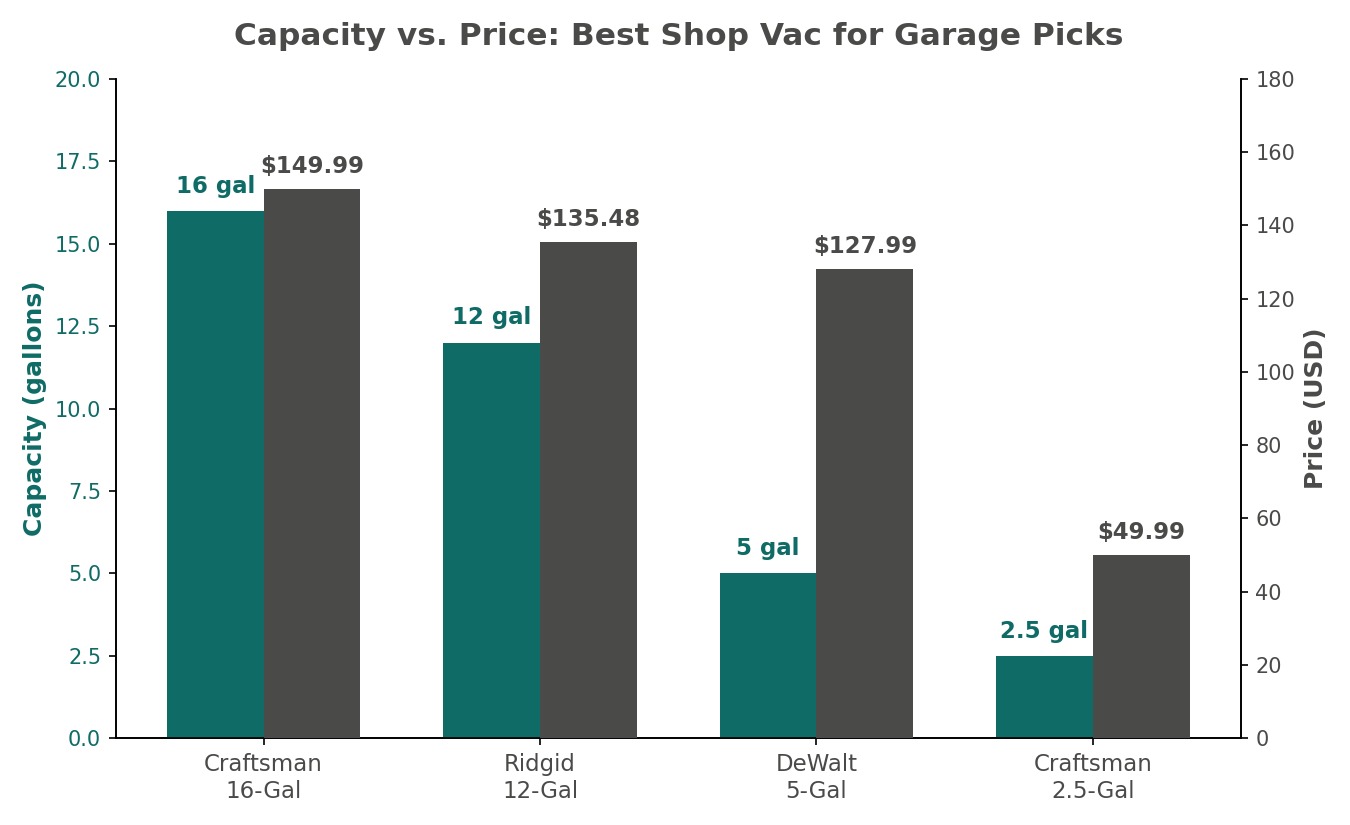
| CRAFTSMAN CMXEVBE17595 16 Gallon 6.5 Peak HP | Best Overall / Heavy-Duty | $149.99 | 4.7★ (8,612) | Check Price |
| RIDGID 62703 RT1200 NXT 12 Gallon | Best Mid-Size All-Rounder | $135.48 | 4.4★ (233) | Check Price |
| DEWALT STEALTHSONIC 5 Gallon | Best for Quiet Operation | $127.99 | 4.6★ (391) | Check Price |
| CRAFTSMAN CMXEVBE17250 2.5 Gallon | Best Budget / Compact | $49.99 | 4.4★ (10,135) | Check Price |
Capacity: How Big Should Your Garage Vacuum Be?
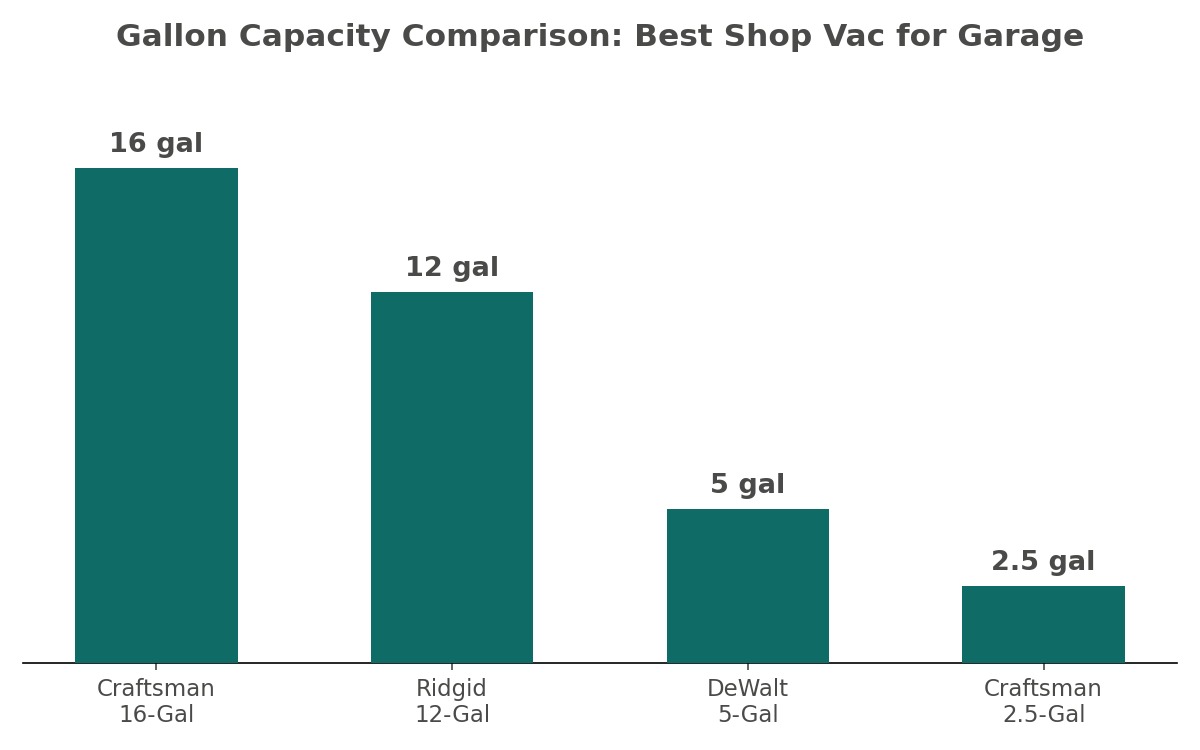
Capacity is the first spec to get right when you’re shopping for the best shop vac for garage use, since it decides how often you’ll stop mid-project. Garage vacuum capacity comes down to how often you’re willing to stop and empty the tank mid-project. A 2.5-gallon unit like the CRAFTSMAN CMXEVBE17250 fills up after roughly one vehicle interior or a single spill.
That’s fine for quick jobs and frustrating for anything bigger. Step up to a 12 gallon shop vac like the RIDGID 62703, and you can run a full garage floor cleanup or a weekend of drywall patching without emptying more than once.
The CRAFTSMAN CMXEVBE17595, a 16 gallon shop vac, goes further still. It’s built for renovation debris, flood cleanup, or a woodworking session that generates a full trash bag of shavings.
If you’re vacuuming more than a single car’s worth of debris in one sitting, size up to at least 12 gallons. Forum discussions among garage and workshop owners consistently point to the 12-to-16-gallon range as the sweet spot for a dedicated garage vacuum, since anything smaller means constant trips to a drain or trash can, and anything larger starts eating floor space you don’t have in a two-car garage.
Suction Power: Peak HP vs. CFM Explained
Suction power matters just as much as capacity when you’re comparing the best shop vac for garage use, since a large tank paired with a weak motor still struggles on heavy debris. Peak horsepower is the number every manufacturer prints on the box, but it’s a lab measurement, not a real-world one.
The CRAFTSMAN CMXEVBE17595 lists 6.5 peak HP, the RIDGID 62703 lists 5.0 peak HP, and the CRAFTSMAN CMXEVBE17250 lists 2.5 peak HP. Those numbers track roughly with what each vac can lift, but they don’t tell you how the motor performs once the filter starts loading up with drywall dust or fine sawdust.
What matters more day to day is airflow, measured in CFM (cubic feet per minute), and suction lift, measured in inches of water or Air Watts, when a manufacturer actually publishes them. A higher peak HP motor pushing air through a clogged filter loses suction fast. That’s why the Craftsman 16-gallon’s wider 2-1/2 inch hose matters as much as its motor size: a bigger opening moves more air at lower resistance, so the vac keeps working closer to its rated power for longer between filter cleanings.
Hose Diameter and Length: Why 2-1/2 Inches Beats 1-1/4 Inches for Garage Debris
Hose diameter is the buying criteria most garage vacuum shoppers skip past, right before they regret it on their first drywall cleanup. It decides what your shop vac can actually pick up without clogging, and it’s the spec buyers overlook most.
The CRAFTSMAN CMXEVBE17595 ships with a 2-1/2 inch hose, wide enough to swallow wood chips, gravel, and drywall chunks without hesitation. The CRAFTSMAN CMXEVBE17250’s 1-1/4 inch hose is built for a different job entirely: car interiors, workbench crumbs, and vacuum-cleaner-style debris, where a narrower hose actually holds more suction per square inch of nozzle.
If your garage cleanup regularly includes anything bigger than sawdust, gravel, screws, or wood scraps, a hose under 2 inches will clog constantly. Length matters less than diameter for cleaning power, but a short hose means moving the whole vac more often. The RIDGID 62703’s locking hose design is worth the extra step of twisting it into place, since a hose that pops loose mid-job is worse than one that’s a few feet short.
16 Gallon Shop Vac vs 12 Gallon Shop Vac: Which Size Wins for Your Garage?
A 16 gallon shop vac and a 12 gallon shop vac look similar on paper, but the gap matters more than four gallons suggests. The CRAFTSMAN CMXEVBE17595’s 16-gallon tank and 6.5-peak-HP motor are built for renovation-scale debris and back-to-back projects without a dump run. The RIDGID 62703’s 12-gallon tank and 5.0-peak-HP motor handle the same categories of mess, just with roughly 25 percent less room before you have to empty it.
The honest answer: choose the 16-gallon Craftsman if you regularly fill a trash bag’s worth of debris in one session, and choose the 12-gallon Ridgid if you want most of that capacity in a frame that’s easier to tuck into a corner. Four gallons doesn’t sound like much until you’re the one carrying a full tank to the drain.
Corded vs. Cordless vs. Wall-Mounted Shop Vacs
For most buyers weighing the best shop vac for garage use, corded remains the safer default over cordless or wall-mounted alternatives. A corded shop vac gives you unlimited runtime and full suction for as long as you need it, which is why every product in this guide is corded.
Cordless shop vacs trade that for convenience: no cord to drag across the garage, but a runtime capped by battery charge and noticeably lower peak suction. That tradeoff makes sense for a quick car interior vacuum, not a full garage floor cleanup or a wet spill that needs sustained power.
Wall-mounted units solve a different problem entirely: floor space. None of the four vacs in this guide are wall-mounted, since a portable unit gives you the flexibility to move between the garage, a car, and an outdoor project without uninstalling anything. If floor space is your main constraint rather than power or capacity, that’s worth researching separately before you commit to a portable model.
Shop Vac vs Regular Vacuum: Why It Actually Matters
The shop vac vs regular vacuum question comes up constantly for first-time garage owners, and the answer isn’t close. A regular household vacuum is built to move air through a sealed bag or canister designed for carpet fibers and pet hair, not wet spills, screws, or drywall dust. Run water, gravel, or fine construction dust through a household vacuum’s motor and filter, and you’ll damage it within minutes, sometimes on the first pass.
A wet/dry shop vac like the four in this guide uses a motor sealed against moisture, a tank built to hold liquid without leaking into the motor housing, and a wider hose rated for debris a household vacuum was never designed to touch. If your garage cleanup involves anything beyond dry dust and pet hair, a household vacuum isn’t a substitute. It’s a different tool for a different job, and using the wrong one is how vacuums die early.
Filtration: HEPA, Cartridge, and Dust Bags for Garage Debris
Filter type decides how much fine dust makes it back into your garage air instead of staying in the tank. Foam filters handle wet pickup well but let fine dust pass through, which is fine for gravel and leaves but not for drywall sanding dust. Cartridge filters, like the ones on all four vacs in this guide, handle dry debris more effectively, and several are washable, which saves money over disposable-only setups.
Fine construction dust is a real health consideration, not just a filtration preference. A 2024 NIOSH health hazard evaluation of drywall sanding found that running a shop vac without its dust bag installed actually put more silica dust into the air when the vacuum was emptied, not less (NIOSH HHE-2023-0028-3396). If you’re doing any regular drywall or concrete work in your garage, pair your shop vac with its dust bag rather than running it bare, and empty it outdoors when you can.
Noise Level: What Decibels Mean for an Attached Garage
Noise level rarely makes anyone’s first list of specs, but it’s a real differentiator among the best shop vac for garage options once you actually live with one. Most corded shop vacs run between 75 and 85 decibels, loud enough to be heard through a shared garage wall. The DEWALT STEALTHSONIC in this guide is built specifically around quieter operation, and Amazon buyers who downsized from louder units consistently mention the difference by name rather than as an afterthought.
If your garage shares a wall with a bedroom or home office, or you’re vacuuming early mornings or evenings, a standard shop vac will announce itself through the whole house. A quieter model costs more for the same capacity, but it’s the difference between using the vac when you actually need to and putting it off until a more convenient time that never comes.
In-Depth Reviews: The Best Shop Vac for Garage Picks
Every product below was checked live on Amazon for current price, stock status, star rating, and seller, and reviewed by real buyers, not just spec sheets. Here’s how each one actually holds up.
1. CRAFTSMAN CMXEVBE17595 16 Gallon 6.5 Peak HP — Best Overall for Garage and Workshop
| Price | $149.99 |
| Rating | 4.7★ (8,612 ratings) |
| Capacity | 16 gallons |
| Motor | 6.5 Peak HP |
| Hose | 2-1/2 in. Dual-Flex |
| Sold By | Amazon.com |
As the top pick among the best shop vac for garage options tested here, this 16 gallon shop vac earns that spot mainly on capacity and motor strength. This is the vac to reach for when the mess is genuinely large.
The 16-gallon tank and oversized drain mean fewer trips to empty liquid waste, and the 6.5-peak-HP motor is the strongest in this lineup by a clear margin. The blower port doubles as a leaf and debris blower for the driveway, which is a real feature and not just a marketing bullet.
Amazon reviewers consistently praise how much dust and debris it clears from garage and shop floors in a single pass, with several comparing its suction directly to name-brand upright vacuums. The most common complaint is the hose itself: multiple reviewers describe it as stiff and unwieldy for anything beyond straightforward floor work, and at least one buyer docked a star specifically for the lack of onboard cord storage.
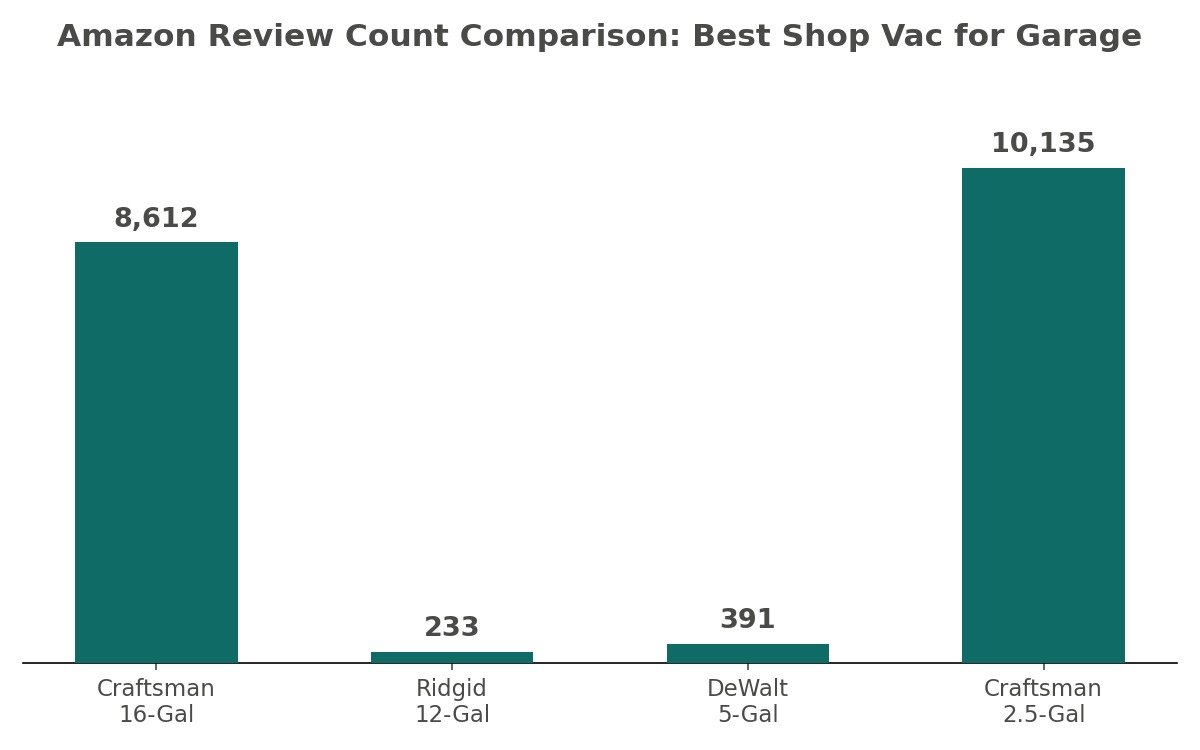
The Ridgid’s much smaller review count doesn’t mean it’s a worse product, but it does mean less real-world validation than the two Craftsman models below.
Pros: Most powerful motor in this lineup, oversized drain for fast liquid emptying, built-in blower port, sold directly by Amazon.
Cons: Hose is stiff and can be cumbersome in tight spaces, no onboard cord storage, plastic casters feel small for the vac’s weight.
Who should buy it: Anyone doing woodworking, renovations, or car work who wants one vac that outlasts several projects. The 16-gallon capacity means fewer dump trips, and the motor handles water extraction and sawdust equally well.
Who should skip it: Apartment-style garages with limited floor space, or anyone who mostly needs quick car detailing. Look at the CRAFTSMAN CMXEVBE17250 below instead.
2. RIDGID 62703 RT1200 NXT 12 Gallon — Best Mid-Size All-Rounder
| Price | $135.48 |
| Rating | 4.4★ (233 ratings) |
| Capacity | 12 gallons |
| Motor | 5.0 Peak HP |
| Hose | Pro Locking Hose |
| Sold By | Acme Tools (third-party) |
This 12 gallon shop vac holds its own among the best shop vac for garage picks despite the smaller review count. The RIDGID 62703 splits the difference between the compact Craftsman and the 16-gallon heavy hitter. Owners who’ve moved up from a smaller unit report it “holds more and is more powerful” than what they replaced, and the four-caster base rotates smoothly even with a full tank.
Build quality is mostly solid, though not flawless. One verified buyer reported the hose sealant detaching on two separate units, which is worth knowing before you buy, even though the overall rating stays comfortably above 4 stars. Note also that this unit ships from a third-party seller (Acme Tools) rather than Amazon directly, which doesn’t affect the product but is worth knowing if you prefer Amazon-fulfilled orders.
Pros: Strong capacity-to-price ratio, locking hose resists disconnecting mid-job, four-wheel base rolls smoothly when full.
Cons: Sold by a third-party seller, one reported hose-sealant defect, narrow crevice attachment clogs with hair and cobwebs.
Who should buy it: Garage owners who want more capacity than a compact vac but don’t need the full 16-gallon Craftsman’s size or weight.
Who should skip it: Buyers who specifically want to order from Amazon directly rather than a third-party seller should compare the Craftsman 16 gallon shop vac above instead.
3. DEWALT STEALTHSONIC 5 Gallon — Best for Quiet Garage Operation
| Price | $127.99 |
| Rating | 4.6★ (391 ratings) |
| Capacity | 5 gallons |
| Motor | 4 Peak HP |
| Feature | Ultra-quiet operation |
| Sold By | ToolDirect, ships from Amazon |
Among the best shop vac for garage options in this guide, this is the one built around a single differentiator: noise. Buyers who downsize to this DeWalt from a larger, louder shop vac consistently say they don’t regret it. One reviewer who replaced a 12-gallon, 5-peak-HP unit called this one “small but powerful,” noting it’s more maneuverable and noticeably quieter, even though it holds less and needs emptying more often.
The quiet motor isn’t a minor feature here, it’s the entire reason to choose this vac over a larger, cheaper alternative. Multiple reviewers specifically praise it for emergency water removal, a task where you don’t want to be fighting both a flood and a screaming motor at the same time. The recurring minor complaint is cord length, which several buyers say could be longer for larger garages.
Pros: Noticeably quieter than standard shop vacs, strong suction for its size, praised specifically for emergency water cleanup.
Cons: Lower capacity means more frequent emptying, cord length is on the short side, ships from a third-party seller.
Who should buy it: Anyone with a garage that shares a wall with living space, or who vacuums at inconvenient hours and needs a machine that won’t wake the house.
Who should skip it: Buyers who need maximum capacity for renovation-scale cleanup should look at the CRAFTSMAN 16 gallon shop vac instead.
4. CRAFTSMAN CMXEVBE17250 2.5 Gallon — Best Budget and Compact Pick
| Price | $49.99 |
| Rating | 4.4★ (10,135 ratings) |
| Capacity | 2.5 gallons |
| Motor | 2.5 Peak HP |
| Hose | 1-1/4 in. |
| Sold By | Amazon.com |
This is the most affordable of the best shop vac for garage picks in this guide, and it’s popular for exactly that reason. It’s built for average household and light garage cleanup rather than heavy workshop duty. Amazon’s own “Overall Pick” badge and over 9,000 units bought in a recent month back up its popularity, and reviewers describe it as versatile enough for cars, spills, and small yard work in the same afternoon.
The tradeoffs are exactly what you’d expect from the price. Reviewers note it runs loud for its size, the narrow tube clogs on larger debris like leaves or wood scraps, and the filter needs regular cleaning to keep suction from dropping off. None of that makes it a bad vac, it just means matching expectations to a 2.5-gallon, entry-level machine.
Pros: Lowest price in this lineup, sold directly by Amazon, versatile enough for cars and small spills, over 10,000 ratings for confidence.
Cons: Loud for its size, narrow hose clogs on bigger debris, filter needs frequent cleaning.
Who should buy it: First-time garage vacuum buyers, renters, or anyone who mainly needs a vac for car interiors and small household spills.
Who should skip it: Anyone doing regular workshop dust collection or wet cleanup should size up to the RIDGID 12 gallon shop vac or the Craftsman 16-gallon above.
Side-by-Side Comparison
| Spec | Craftsman 16 Gal | Ridgid 12 Gal | DeWalt 5 Gal | Craftsman 2.5 Gal |
|---|---|---|---|---|
| Price | $149.99 | $135.48 | $127.99 | $49.99 |
| Rating | 4.7★ | 4.4★ | 4.6★ | 4.4★ |
| Review Count | 8,612 | 233 | 391 | 10,135 |
| Motor | 6.5 Peak HP | 5.0 Peak HP | 4 Peak HP | 2.5 Peak HP |
| Best For | Heavy-duty workshop use | Mid-size all-rounder | Quiet operation | Budget / light duty |
| Where to Buy | Check Price | Check Price | Check Price | Check Price |
Which Shop Vac Fits Your Garage?
The right pick depends less on which vac is “best” in the abstract and more on what your garage actually needs on a typical weekend. Match your real use case against these four before you decide.
Choose the Craftsman 16 Gallon if you do heavy workshop or renovation work
- You generate a full tank of debris in a single project
- You regularly vacuum both wet spills and dry sawdust
- Floor space for a larger unit isn’t a constraint
Choose the Ridgid 12 Gallon if you want a capable all-rounder
- You need more than compact-vac capacity without going to 16 gallons
- You’re comfortable ordering from a third-party Amazon seller
- You want a locking hose that won’t pop loose mid-job
Choose the DeWalt STEALTHSONIC if noise is your main constraint
- Your garage shares a wall with living space
- You vacuum early mornings, evenings, or around a sleeping household
- You’ve dealt with emergency water cleanup before and want it handled quietly
Choose the Craftsman 2.5 Gallon if you want an affordable, portable option
- Most of your cleanup is car interiors or small spills, not full workshop debris
- You want a low-cost second vac to keep in a vehicle or on a workbench
- You’re a first-time buyer who isn’t ready to commit to a larger unit
How Do You Keep a Shop Vac’s Suction From Dying Early?
A well-maintained garage vacuum keeps its rated suction for years instead of months. Most suction loss comes down to filter neglect, not motor failure.
Rinse foam filters with plain water after wet use and let them air-dry fully, usually about 24 hours, before reinstalling. A damp filter sealed back into a tank grows mildew fast in a humid garage, and a mildewed filter restricts airflow even when it looks fine.
For cartridge filters, tap them against a hard surface to knock dry debris loose rather than rinsing, since water can drive fine dust deeper into the pleats instead of out. Avoid compressed air on cartridge filters specifically.
It’s a common shortcut, but it pushes fine particles through the filter media instead of removing them, which quietly shortens the filter’s effective life. If your hose has developed a permanent kink, storing it uncoiled on a wall hook rather than looped tightly around the handle prevents new kinks from setting in the material.
Frequently Asked Questions
What size shop vac do I need for a garage?
There’s no single best shop vac for garage size that fits everyone, since matching capacity to your actual project size matters more than chasing the biggest tank. For occasional car detailing or small spills, 2.5 to 6 gallons is enough.
For general garage floor cleanup or regular workshop dust, most owners are better served by 9 to 16 gallons so they’re not stopping to empty the tank mid-project. If you’re unsure, start with the mid-size range since it covers the widest set of real-world tasks without the bulk of the largest units.
Can a shop vac clean up water in a garage?
Yes, and this is the core of the shop vac vs regular vacuum difference. Every wet/dry shop vac in this guide is built to vacuum standing water and spills directly, unlike a household vacuum. Switch to the foam wet filter before vacuuming liquid, then drain the tank through the built-in port rather than lifting a full tank to a sink.
Is a bigger shop vac always better for garage use?
No. When people search for the best shop vac for garage use, they often assume bigger automatically means better, but a larger tank means more weight to move and less flexibility for quick jobs like vacuuming a car interior. The CRAFTSMAN CMXEVBE17250 at 2.5 gallons outsells larger models specifically because most garage tasks are smaller than people expect.
Final Verdict: The Best Shop Vac for Garage Cleanup
Picking the best shop vac for garage cleanup comes down to matching capacity and hose diameter to your actual projects, not chasing the biggest tank on the shelf. For most garages, the CRAFTSMAN CMXEVBE17595 16 Gallon is the pick that earns its floor space.
The motor and drain handle both dry debris and wet cleanup without complaint, and the price stays reasonable for what you get. If a 16-gallon footprint is more than you need, the RIDGID 12 Gallon covers most of the same ground in a smaller frame, the DEWALT STEALTHSONIC is the right call if noise is a real constraint, and the CRAFTSMAN 2.5 Gallon is hard to beat for a first vac or a secondary one to keep in the car.
This post sits under our Vacuums & Floor Care category alongside our other cleaning equipment coverage. For the full picture of how we approach product selection, see how these reviews work, browse our full lineup of cleaning products by category, or check the complete archive of PureHomeLab reviews for more buying guides as they go live.
As an Amazon Associate, this site earns from qualifying purchases made through the links above, at no extra cost to you. Full details are on our affiliate disclosure page.